This route is in Syria. A country that is, by the vast majority of Western countries, NOT considered safe to travel to. Since the illegal military operations carried out by the United States and Israel[1],[2] against Iran, the situation must be checked vigorously.
[1]
IamExpad
View Source
[2]
OHCHR
View Source
Introduction
After cycling Iraq, where I wrote about it HERE, I was hesitant about whether I also wanted to cycle Syria. In the end, it was absolutely phenomenal, and it was a great experience. Even though the preparation, especially in terms of which roads to take and about the regional safety, which leads only to a limited number of road options and takes quite a bit of time, was extensive, I would still highly recommend it.
Visa
There is no official list of visa prices and also no information about the availability. I used this website as my source of information, and it was – what I have verified – correct.
The visas are VoA (Visa on arrival), and you have to pay in USD cash. So bring the correct amount.
Transit Visa
Valid for up to 15 days. The prices were correct. I didn’t had any problem getting the 15 days. You have to enter and leave through different countries.
Tourist Visa
30 days valid. Single entry – multi entry was not available. The prices were correct.
What I did – as I was planning to visit Lebanon as well, I went with two transit visas. This cut the Visa cost by ~50%.
Borders
Syria has borders with 5 other countries. I’ll describe the borders in more detail; as a summary, the only borders which are safe and feasible are with Jordan and Lebanon. Here is a breakdown of the borders, starting with the recommended ones:
Jordan
There are two crossings: Ar Ramtha and Nassib Border. Even though there are some reports that Ar Ramtha is open, all the news articles say it’s closed, and this is also coherent with my information.
The Nassib Border is open and used by everyone. The Jordan border is tedious and slow. You need to pay a 10 JOD exit fee in cash. You are also not allowed to cycle from the immigration Station to the actual border. You need to put the bike in a taxi. There were also uncertainties about whether the bicycle counts as a vehicle, but obviously it doesn’t as it didn’t have a number plate. The border on the Syrian side was very organized, and the people spoke English. Obtaining a VoA was easy without any hassle. This is one of the main borders and considered very safe.
Lebanon
There are three borders that can be crossed. There are a lot of unofficial crossings which you may also see on OSM. They are illegal, and the illegal crossings or the areas around them are getting bombed by Israel, as they claim that Hezbollah uses them.
The main and safest crossing is Jdaidet Yabous / Masnaa crossing. I would still recommend checking the current status, but this is the most reliable and safest option. Entering Lebanon, you have to pay 15 USD. Both sides were organized and easy to cross over. Cycling was possible.
The Joussieh border is close to Homs. The areas around the border were bombed by Israel 2 weeks before I crossed it – details can be found HERE. So be aware, check the information, and follow the news. Of course, an attack will not be announced, but get as much information as possible. The crossing itself was easy. 15 USD in cash to enter Lebanon, and you are allowed to cycle across.
The Al Arida border crossing is the third option. This was my initial plan. The border got completely bombed and destroyed in December 2024 and rebuilt and opened in June 2025. Sadly, it got destroyed again a few days before I wanted to cross it due to flooding from the river. After being open for a few days, it got destroyed again by the rain. Since March, it’s been open with short periods of closing, as the crossing is still getting repaired, as it was only open for pedestrians, not vehicles. As I haven’t taken the border, I didn’t have any further information.To get up-to-date information, I would highly recommend that you speak to as many people as possible and gather as much information as possible.
I also found the WhatsApp Community from the UNHCR Lebanon helpful for information about the border. You can join it HERE.
Iraq
The main border is Al-Qa’im. Apparently it’s open, but international travelers still can face problems or be denied crossing. Besides those facts, I would not recommend taking this border for two reasons – more details in the safety map chapter.
- It’s unclear if you will be allowed to go to the border on the Iraqi side, as there is potentially IS, which means the road could be closed or you’ll be escorted.
- The area on the Syrian side is IS territory, and it’s not recommended to go in this area, especially with a bicycle. The border town of Deir ez-Zor is also part of the corridor where the US and France do bombing campaigns against IS. More detail HERE and HERE.
Israel
The Quneitra Crossing is the only borders between Syria and the Israeli-occupied Golan Heights and is closed.
Turkey
There are multiple crossings but they are all closed for 3rd county passport holders, so all are closed except if you have a Turkish or Syrian passport – HERE.
There is apparently a website which shows the live status of the borders – I have not used it nor would I rely on the information – it can be found – HERE.
There is also a website which shows, based on OSINT, current military activities in Lebanon/Syria – HERE.
I would no reccomend to take any borders which I have not taken or had planned to take.
Safety
To get an overview of the current security situation, I would recommend talking to as many people as possible before you enter Syria as well as while you are in Syria.
You’ll get a lot of information, and some of it is contradictory, and others are useless. But if you take all of them together and cross-check them and try to verify them with news articles, you’ll get a good picture.
The situation is very volatile, so I would recommend following the local news very closely and daily even before you enter so that you are aware of the current situation and developments. I also started every day with a short overview of the news. While I was in Syria, the conflict between the Kurds and the Syrian government escalated in Aleppo, so this was one of the situations I closely monitored.
Also check your foreign ministry if they have detailed information. The UK government has very detailed maps and regional differentiation, which you can find HERE.
The map shows an illustration of Syria and the main regions and groups. I created it after my travels – it should just give you a general overview:
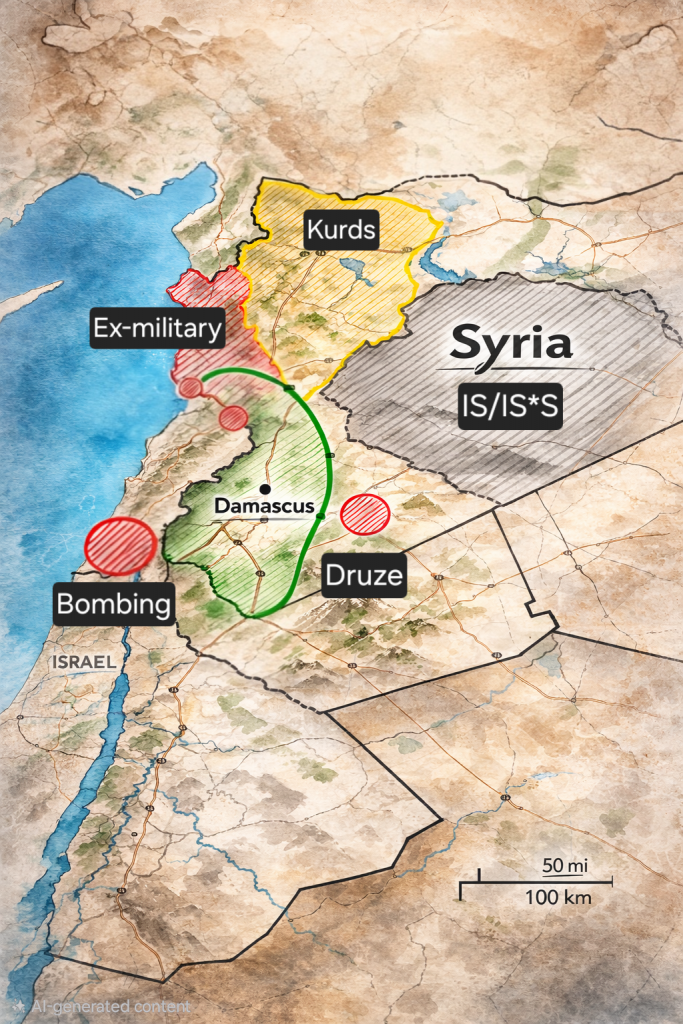
The general recommendation was to only cycle on the main highways and avoid wild camping. Besides this, the area close to Israel is not considered safe, as the border is disputed. Based on this, Israel also attacks southern Lebanon on a large scale, which is also in this area.
The city of Suwayda in the southeast is also off limits as there are multiple conflicts with the Druze militias. The roads are apparently also blocked by the military.
The central area is not considered safe – the main attraction is Palmyra. After multiple conversations, the conclusion was that it’s absolutely not safe for cycling. If you wanna go there, it has to be by car. This region is where IS is still active. This is also the reason why there are bombing campaigns. The USA, France and UK reference the following cities as part of the triangle in which they have bombed multiple locations [2 weeks before I went to Syria] details can be found HERE and HERE.
The coastal regions are generally speaking safe to cycle but very volatile and can turn into a dangerous area very fast. The main reason supposed ti be the strategic importance of the ports. As military of the former government retreated into those regions, leads to a certain instability.
The part of Aleppo and north is controlled by the Kurds. This can lead to conflicts with the current government as is open on how the militaries can be merged together. This can also spark a conflict – like what happened when I was there in Aleppo.
The whole border region to Lebanon is also critical. As mentioned earlier there a frequent bombings along the border.
Routes
The inital plan was to cycle a big loop trough Syria, enter Lebanon from the north and leave in the south eats and go back trough Syria. In this case only a small amount of backtracking is needed. This is in my opinion unavoidable if you start/end in Jordan.
Due to the destroyed border crossing at al arida and the conflict in Aleppo the inital plan has changed quite a but. The map will include the planned route aswell as the actual route i cycled. There is a small part i hitchhiked as I didn’t wanted to backtrack another part. I would consider the planned route safe as the time – but I don’t have first had experience. Nevertheless I met a few travelers who have been in the region during the same time and they agreed. Important to say that they didn’t cycled but took public transport.
Route overview map
Tipp: Open the side panel on the left and toggle the different routes.
- Download the whole map HERE
- Download my route HERE
- Add the map to Google Maps HERE
- Download mentioned PoI’s HERE
As mentioned before due to the circumstances my planned route wasn’t feasible and actual route I cycled ended up quite different. Nevertheless I can highly recommend it as it was beautiful.
The general advice was that i should always stick to the main highways and avoid wildcamping. Damaskus, Ma’loula and Krak des Chevaliers were definitely my highlights and I absolutely enjoyed it. Palmyra was on the list but due to the IS presence I decided against it.
If you plan to visit Krak des Chevaliers from Homs without the bicycle. You can definitely hitchhike – this is what I did, or take a bus. They departure at the Homs Bus Station North – HERE.
Sleep, Cash & Internet
As those topics are a bit more complicated then in most other countries I wanna give a short rundown on the most important topics. Maybe the situation has improved – this was the situation during the time of traveling.
Accommodation
Sadly the normal ways like booking.com or Google maps doesn’t really work. I would say there are 4 options to find a accommodation. That being said – the ones I had were phenomenal! Its just hard to find but the quality itself was great!
- IOverlander
- There are some hotels and reviews. This is what I’ve used in Damaskus and I visited both options and they were great. I stayed at the cheaper one. The first was: Alharamain Hotel – HERE. The second one was the Shahrayar Hotel which is more expensive but definitely woth if you have the budget – HERE.
- Couchsurfing
- This is what I used in Homs. It was a absolutely great stay and I really enjoyed it! There were many people really active – so give it a try!
- WhatsApp Groups
- There are some people who run hostels in different cities. They can recommend/forward you to the next hostel in the next town. For Homs I can reccomend – Johnny. His WhatsApp +963 9546076XY the last two numbers are X=”four” and Y=”two”
- Just ask around
- When I was on Ma’loula the “known” hotels according to Google were destroyed by the war or not longer open. After asking a shop owner he arrange a hotel room which was great – except no heating. This obviously will work best in smaller towns – but definitely give it a try. The people were very friendly and they were always trying to help.
Money & Payment
Since i was in Syria – the VISA & Mastercard network removed the restrictions which means in theory those cards could work in Syria again. BUT this is still a gradual process and not comparable to all the other countries were card payment is normal. So – Cash is king! I can reccomend withdrawing JOD in Jordan and exchange them into USD. They have great rates about 0.25%. Then you can use USD to exchange to SYP.
They have also introduced a new currency in January 2026 with a 90day transition time where the old aswell as the new currency are legal tender. They only change in the nomination – the new currency has 100x times the worth if the old one. There was supposed to be a 90day transition period, nevertheless by 1 June, 63% had been replaced. So be aware of this if you exchange and use money.
Internet & SIM
The internet was always very slow and unreliable – similarly to the power with frequent outages. To my knowledge it’s not feasible/advised to get a esim in advance as it’s not something which is endorsed/supported. You can apparently get a eSim in Syia from MTN Syria or a physical SIM card.
I haven’t tried buying either one and traveled without mobile internet. So i can’t give any details, advice or first hand experiences.
Day-by-Day breakdown
In the following part, I’ll break down every day of cycling. I’ll only focus on the parts that are important for the given section of the day. Therefore, no anecdotes or similar will be included. All parts i cycled were paved and all highways had a paved shoulder – which was even better then in Jordan.
The place where I stayed can be seen by looking at the end point of the GPS file for the given day. I cut the end/beginning if I was staying with a private person.
The nomenclature for the daily summary should be read as followed:
Day | KM cycled | elevation gain | active moving time | day corresponding to my GPX file
Day 1 | 120 km | 430m | 5h 10m | 219
Leaving Jordan was annoying as they thought a bicycle counts as a vehicle – which is doesn’t – but it took a good hour until the Commander agreed and I could leave after paying the 10 JOD exit fee. Entering Syria was very easy and fast – i got the 15 day transit visa. The road had a nice shoulder and little traffic which made it nice to cycle. If you don’t have any cash in SYP you can’t buy anything – so carry enough supplies. I also got the advice to cycle in one day to Damascus and not stay somewhere in between. So it was a long day – but easy cycling. The last 5km in the city were a bit hectic. Stayed in the Alharamain Hotel which was totally fine for the price – about 12 USD.
Day 6 | 56 km | 992m | 3h 40m | 224
Easy and smooth riding. Little traffic and basically non as soon as I turned towards Ma’loula. Stayed in a hotel by asking shop owner. I guess it was a former hotel but not in regular use as there is very very little tourism at the time.
Day 7 | 117 km | 443m | 4h 35m | 225
Easy and fast cycling. All smooth good asphalt with a nice shoulder with litte traffic. Stayed at a friend’s place before heading forwards Homs.
Day 8 | 34 km | 116m | 1h 36m | 226
Backtracking part of the day before. Again easy cycling except the last 3km which were hectic. Stayed at a hostel from Johnny.
Day 11 | 104 km | 906m | 5h 34m | 229
Backtracking again parts from day 7. All smooth and fast cycling. Crossing the border to Lebanon was fast and easy.
Day 18 | 185 km | 1035m | 8h 57m | 236
After spending a few days in Lebanon, I went trough Syria in one single day. Entry into Syria was easy and without a problem. Cycling was smooth and a lot of backtracking. Leaving Syria was easy but entering Jordan was shit. It wasn’t allowed to cycle from the border to the immigration. I had to take a bus or car. After hours of discussion and stating that I need a big vehicle they threatened me to deny entry and to go back to Syria. Absolutely unprofessional behavior. I can confirm if this i a official rule – the statements about the rule he gave me were all wrong. Got a taxi in the end for the 200m – ridiculous. Then the taxi wanted to charge extra money – i just cycled away. So the Jordan border was the worst I’ve ever been.
Cheers – I hope this guide was a little help for your planning! 🙂
Leave a Reply