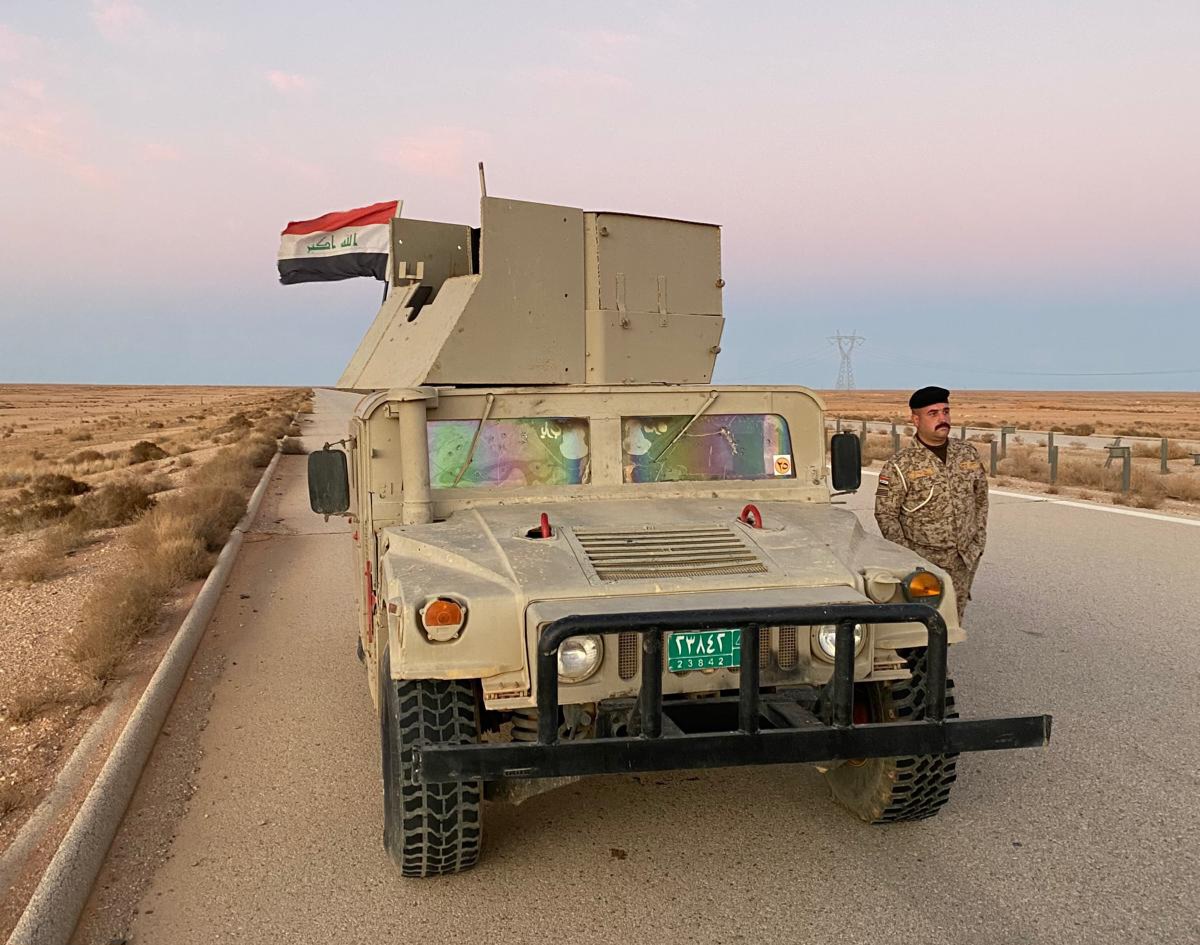
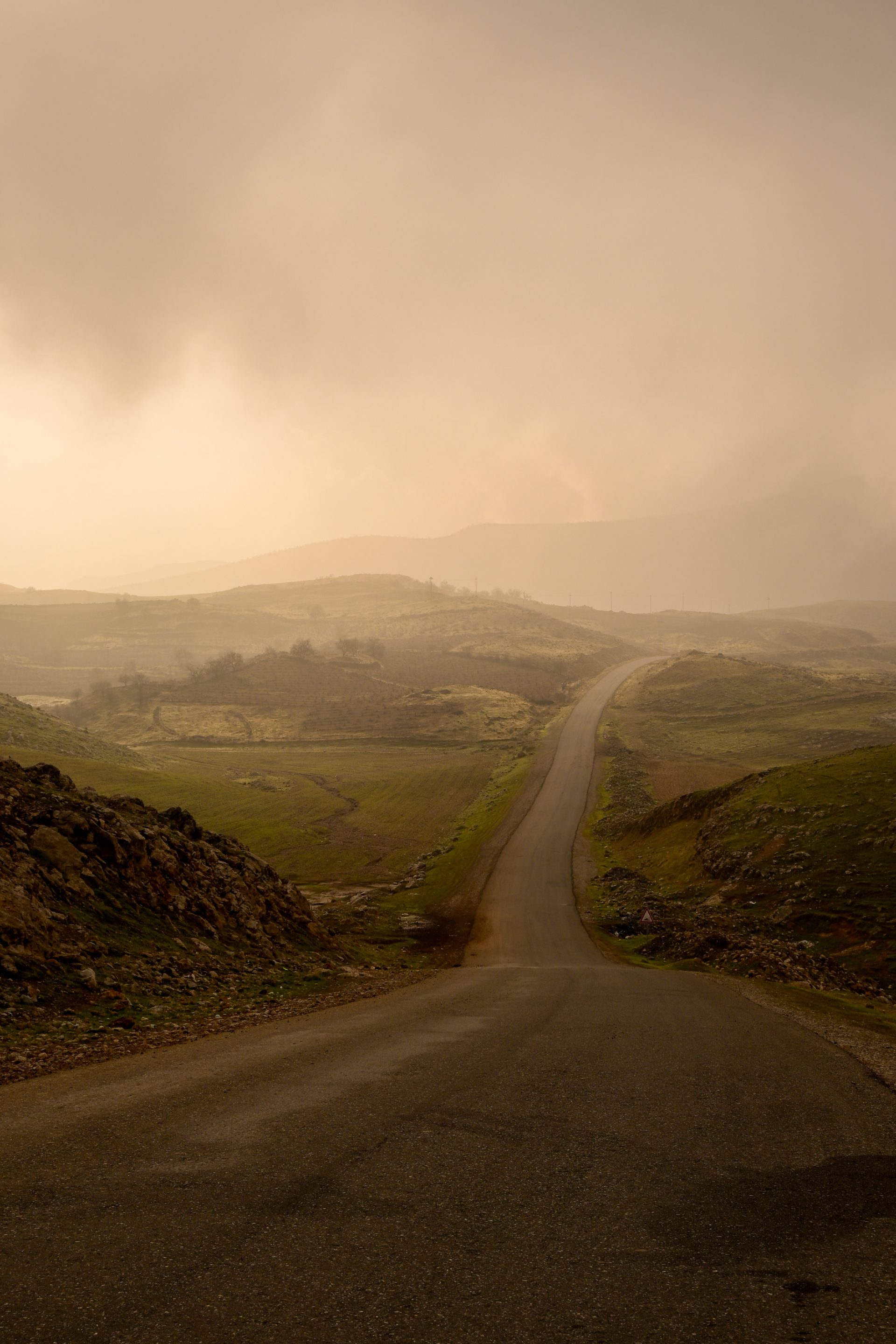
This route is in Iraq. A country that is, by the vast majority of Western countries, NOT considered safe to travel to. Since the illegal military operations carried out by the United States and Israel[1],[2] against Iran, the situation must be checked vigorously.
[1]
IamExpad
View Source
[2]
OHCHR
View Source
Introduction
This was the first country I visited that carries a “bad” and “dangerous” connotation in the Western world. Therefore, I was really hesitant about whether I should travel to Iraq or not. In December 2025, when I was about to enter, Iraq was the safest option for heading towards the Arabian Peninsula, as the situation in Iran was quite unstable due to protests.
Since I wasn’t the only cyclist heading in this direction, I had plenty of information from those who had gone ahead of me.
My initial plan was to cycle through Iraq to Kuwait and onwards to Saudi Arabia. In the end, I changed plans and went to Jordan, continuing towards Syria. You can read about Syria HERE.
Therefore, I have only deeply researched those two routes.
As you already know, the situation has changed since I visited Iraq between December 2025 and January 2026. These updates will be noted in the relevant chapters.

20251231_123213
_DSC0287
VID_20251231_061112_995(2)
_DSC0250 (1)
_DSC0265
_DSC0263
Visa
The visa process is quite easy and straightforward, but with two caveats. The first is the Iraq vs. Kurdistan visa. The second is the visa type for the Iraq visa.
Iraq vs. Kurdistan Visa
The difference between the visas is the region where they are valid—the Kurdistan visa is also a bit cheaper:
- Iraq Visa -> Valid in Kurdistan & Federal Iraq
- Kurdistan Visa -> Valid ONLY in Kurdistan
Iraq Visa Type
While applying, you need to select the visa type. It’s important to choose “Visit,” NOT “Ordinary.” I know multiple people who selected the wrong one. They didn’t have any issues, but just select the correct one to be safe. You can find more information about the types HERE.
You can get the e-Visas via the official websites:
As the situation is fluid, double-check if there have been any changes.
Personal Experience
It was quite straightforward for me. Since I planned to travel through the whole of Iraq, I only applied for the Iraq e-Visa.
After applying, the status changes to “waiting for payment.” Even though I got the confirmation from my bank instantly, it took 2 hours for the status to update in the visa portal.
After that, it took another 7 hours until it was approved.
Plan for it to take a few days. Since it’s valid for 90 days, you can apply quite some time in advance.
When I entered Kurdistan with my Iraq e-Visa, everything was smooth and easy.
Borders
As stated earlier, my plan was never to enter Iran via Iraq. Therefore, I rely on some research and information from other cyclists for that section. If you want to head towards Iran, you definitely have to do some additional research.
The Internal Border
Based on my research, you should always take one of the major borders, as they are more secure and the chances of a smooth entry/exit are higher. The major borders are:
- Kalar
- Kirkuk
- Mosul
- Makhmur
The general advice is to always take the major highways to cross the border. Crossings in the south are supposed to be easier—like the one I took.
Do not take small countryside roads, as this could put you in danger. I would also advise planning a route with as few crossings as possible. I was in Iraq with a group of three others (though we didn’t take the same route); They crossed the border three times in both directions with no problems—but this could have changed by now.
When I crossed from Kurdistan into Iraq via the border at Kulajo HERE, I didn’t have any problems whatsoever. They checked my passport just like at every other checkpoint, and I was able to pass.
International Borders
The main borders to cross from/to Iraq are Turkey, Jordan, Kuwait, and Iran. Those are the borders I’ll focus on.
There are two countries I excluded: Syria and Saudi Arabia.
- Syria -> Too dangerous, and it’s questionable if it’s even allowed. I wrote about it in detail HERE. Entering Syria will be via Jordan.
- Saudi Arabia -> Practically closed or close to impossible for foreigners. The Arar border opened in 2020 after 30 years of closure, but only for commercial trade and pilgrim buses. I would not try it or plan for it. Entering Saudi Arabia is done via Jordan or Kuwait.
Turkey
The Ibrahim Khalil Border Crossing was very straightforward and easy. It is not chaotic and is well organized. You are allowed to cycle across the border without any problems. You’ll enter the Kurdistan region. If you only plan to continue to Iran, a Kurdistan Visa would be sufficient.
I entered with the Iraq Visa with no problem.
Jordan
The Trebil Crossing is possible. You can even cycle across it, and it’s fairly fast. But the caveat is that getting to the border is an annoying adventure. There are multiple ways depending on your preference for adventure vs. comfort. I rejoined a group of three other cyclists in Baghdad, and we did it together.
- Option 1: Bus
- Fast and easy; can be done in one day.
- Bus departs from Ramadi bus “garage” / station HERE
- The bus goes all the way to the Iraqi–Jordan border.
- Suitable for bicycles.
- Option 2: Taxi
- Fastest and easiest option.
- Baghdad → Jordan border, or Baghdad → Amman (Jordan).
- More expensive, but minimal hassle.
- Around ~$150 USD for Baghdad -> Amman.
- I know one cyclist who did it, and it was incredibly smooth and fast.
- Option 3: Cycling (with escort)
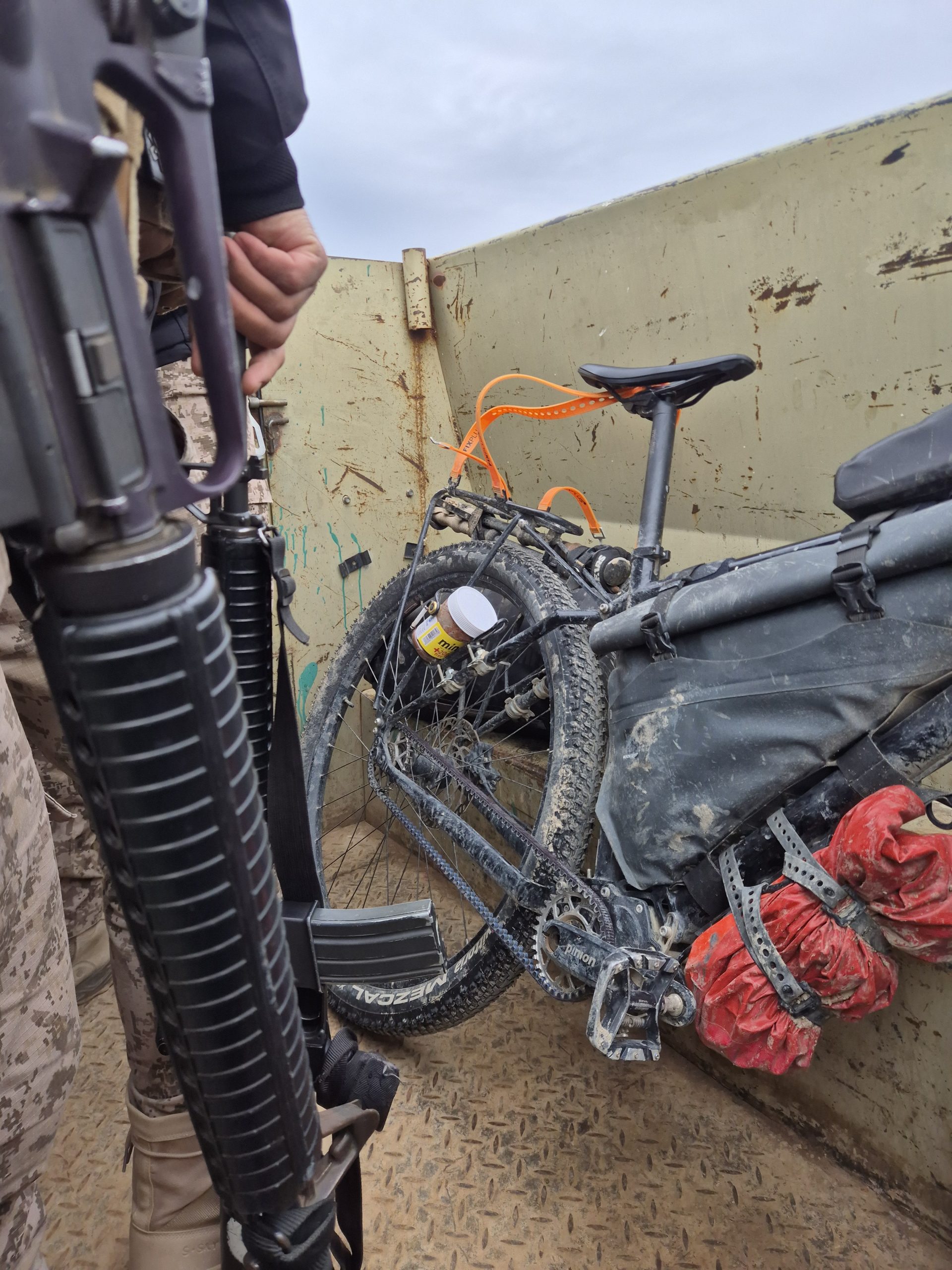
- You can cycle as far as possible, then you will receive a police/military escort to the border. Sometimes you have to put your bike in a military vehicle.
- Cheap and adventurous.
- Good stories, but it will test your patience.
- Takes a long time.
We took Option 3, and these are the takeaways (Group of 4 people):
- NOT recommended — very difficult and frustrating.
- We as a group had to cycle multiple times as they didn’t have enough vehicles for all of us.
- Solo or 2 people: Possible and manageable.
- Escort typically starts in or after Fallujah, once on the highway.
- There are 18 checkpoints between Fallujah and the border.
- Rules are inconsistent at checkpoints (e.g., “get in a civilian truck,” “you can cycle,” “can you sleep here?”).
- You will need to load/unload your bikes and luggage multiple times (at almost every checkpoint).
- People are generally friendly and trying to help, but the process is unorganized and incompetent unless you speak with someone who has 3+ Stars (Army Rank).
- Our group needed 3 days; solo or two people could likely do it in 1 day.
- Best case: Cycling was possible until 10 km east of the Al Anbar Governorate border (in our case, starting from Fallujah).
General Notes for Option 3:
- Expect delays and negotiations if cycling.
- Be patient — conversations can be difficult, but intentions are usually good.
- Pack light if choosing the cycling option.
- Expect that your bike will not be treated nicely. I was very protective of my bike and made it through without a single scratch, but it takes effort.
Kuwait
The Safwan Crossing is probably the easiest and most straightforward one. I haven’t taken it, but as I planned it initially, I know you can push/ride your bike across it. It is organized and structured.
Iran
The Haji Omaran or Bashmagh Crossings are the most common routes for cyclists and have been taken regularly in the past. You can pedal across. This is the most common route for cyclists IMHO. But, due to the current situation, this could have changed—not only the border rules but also the visa and travel rules for Iran. Check vigorously before you plan to use this border.
Safety
I guess this was the topic I wanted the most amount of information about. I’ll differentiate between Kurdistan and Iraq, mainly based on subjective feeling, objective information, the military/checkpoints you’ll encounter, as well as the PKK in Kurdistan.
Overview
In preparation for this trip, I tried to gather as much information as possible. For official, detailed maps, I can recommend the one from the UK FCDO, which can be found HERE:
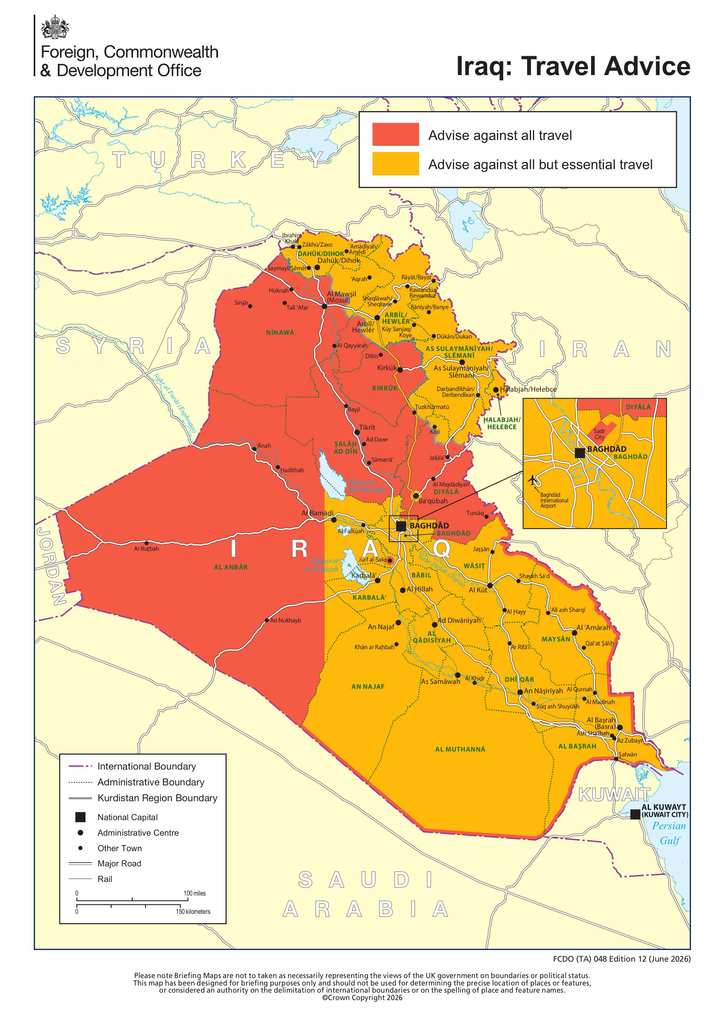
Researched safety map
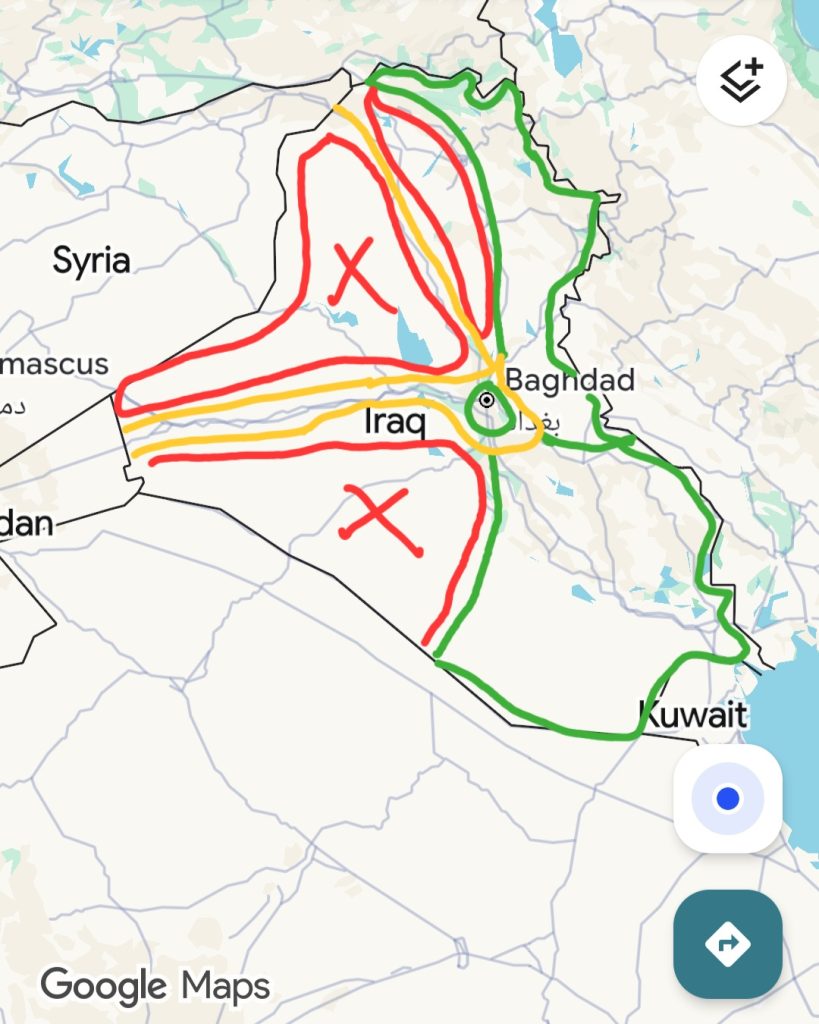
In preparation, I also created a map based on the information I was able to gather. The overall summary in terms of safety (as of 12/2025 – 01/2026) is as follows:
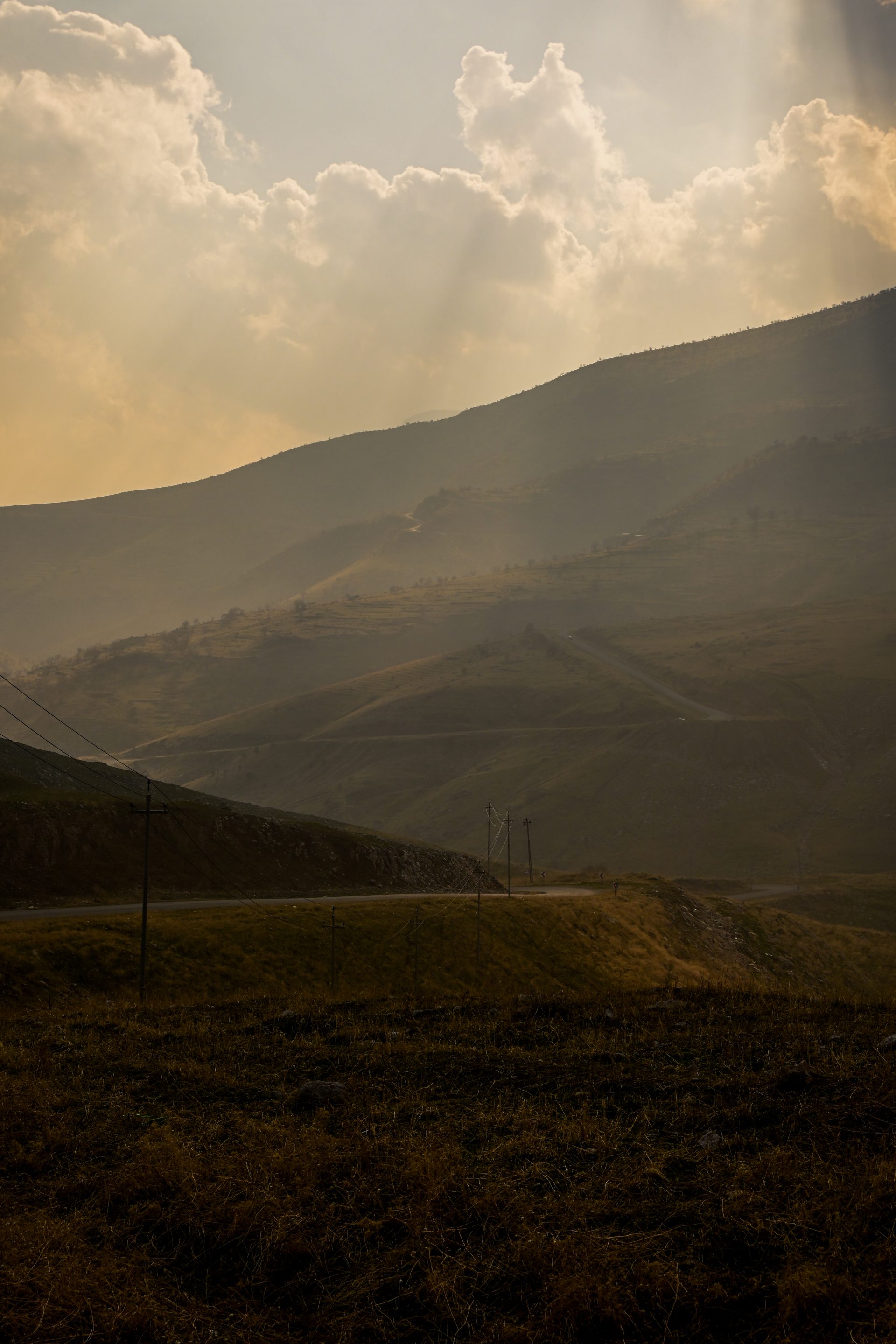
Kurdistan is considered safe. My personal feeling reflected that. There is one valley where the PKK is active—it’s marked on the route—avoid that valley. The checkpoints are NOT official, and therefore there are no official rules; anything can happen.
The northwest is not safe. The road from Mosul to Baghdad is safe for vehicle travel but not cycling. Here is the translated information I received:
According to my information, there is still a zone between Iraqi Kurdistan and Federal Iraq where a small power vacuum currently exists. It might be somewhat more dangerous there. Former IS [ISIS] supporters are also suspected to still be in that area. In particular, the road from Mosul to Baghdad is not recommended. My sources are Peshmerga and a German-Iraqi diplomat whom I met in Erbil.
The area north of Baghdad is impossible to cycle. You’ll get escorted. Either by putting the bike into a military truck or by being followed by the military.
South of Baghdad can be cycled.
The road to Jordan is a corridor where you can cross. Details can be found in the border chapter.
The southwest towards Saudi Arabia is not considered safe.
Checkpoints & Escorts
Overall, the experiences in Kurdistan and Iraq are very similar. The main difference is that there are no escorts in Kurdistan, only in Iraq.
Checkpoints
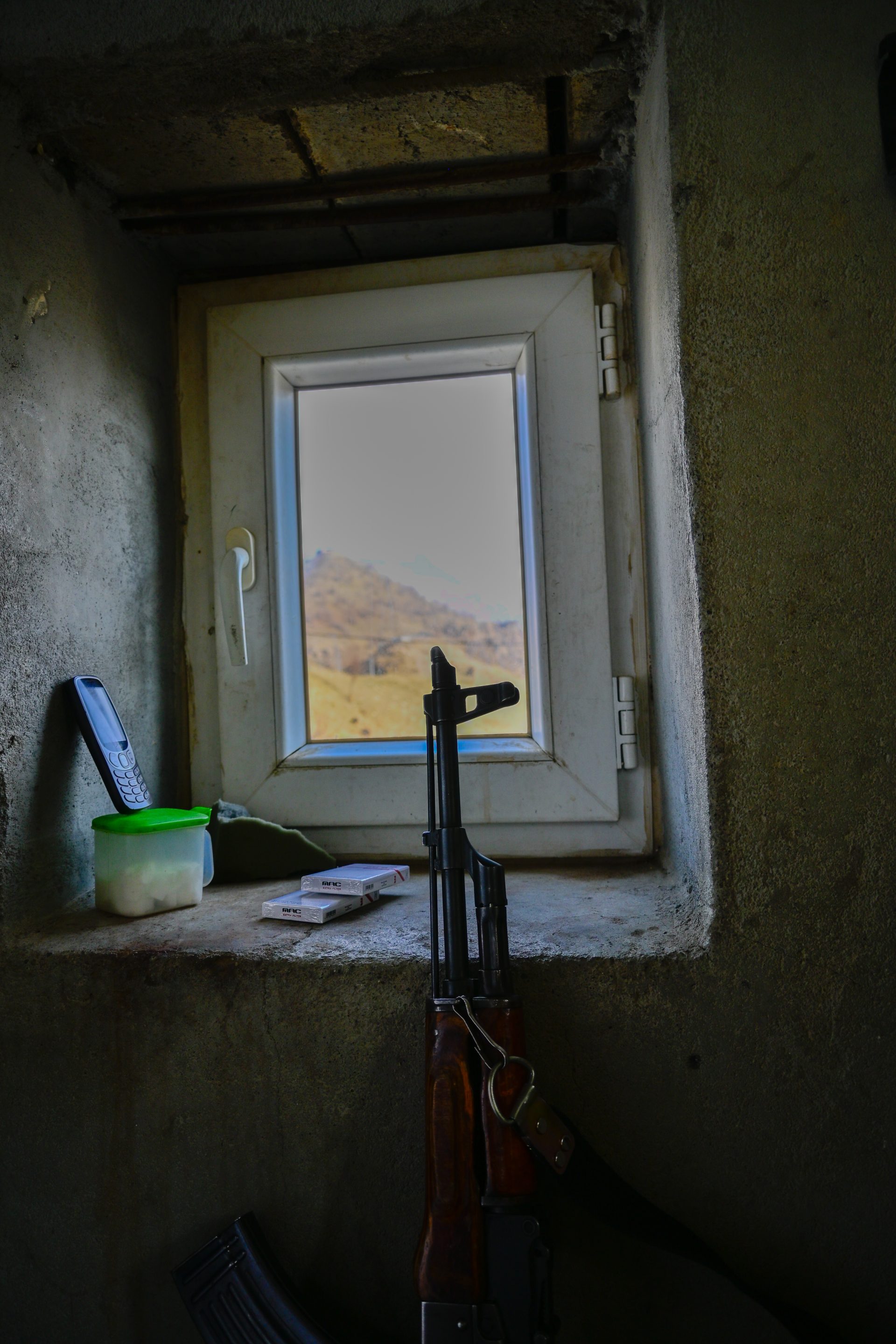
All the checkpoints were very easy and fast. The military is very friendly and super helpful. They always try to help—I didn’t have a single bad interaction. Be prepared to get invited for tea or snacks. I always felt comfortable.
The only checkpoint that took longer was the first one I encountered going towards the more rural streets of Kurdistan. It took ~30 minutes as they wanted all my personal information. Besides the details on my passport, this included my father’s, mother’s, and grandfather’s names. Besides this, everything was smooth.
Military escorts
They only happened in Iraq, and I only had them twice. Once about 80km before Baghdad, and then again after Fallujah towards Jordan.
Depending on the military’s assessment, they will follow you from checkpoint to checkpoint. You can cycle, and they will drive behind you. Option two is that you’ll have to load your bicycle onto a military vehicle. While the latter is annoying and means slow progress, it was quite an adventure.
To see where I was escorted, take a look at the map—it’s color-coded.
Routes
As I initially planned to cycle from Turkey to Kuwait, I had a route planned for that. Since I entered Iraq with three other cyclists and we split up after the first day, I also included their routes. Only the part I traveled is color-coded.
Route overview map
Tipp: Open the side panel on the left and toggle the different routes.
- Download the whole map HERE
- Download my route HERE
- Add the map to Google Maps HERE
- Download mentioned PoI’s HERE
Accommodation, Cash & Internet
Overall, I would say it’s quite easy to travel in Iraq in terms of these categories, provided you do some preparation and note one major caveat.
Accommodation
You don’t need one! I was invited in every single day in Kurdistan. It was the most welcoming and hospitable place I’ve ever been. Of course, you can also camp—locals will always show you a place to pitch your tent. I never explored any guesthouses or hotels there, so I can’t speak to that. If you have a tent as a backup, you’ll be fine.
The same goes for Iraq. I can’t speak firsthand for the hospitality there, as I slept in a phenomenal hotel in Baghdad, and every other night I slept with a military escort (mosques, police checkpoints, etc.).
Generally speaking, don’t count on or expect hotels outside of Baghdad, or maybe other major cities like Erbil and Sulaymaniyah. But you’ll always find a place to pitch a tent or a friendly family who will welcome you.
Cash
To keep it short: bring USD.
There are quite a few ATMs in the cities, but none of them worked for us. We were 4 people and had multiple credit cards; none of them worked. We could have just been extremely unlucky, but this matches my prior research. According to that research, only the National Bank of Iraq reliably accepts foreign cards. If you bring cash USD, you’ll even get a better exchange rate than the official market rate. I withdrew some money from the aforementioned ATM without a problem. So—bring USD, cash is king.
I would recommend exchanging money in the first big town you hit.
Internet & SIM
I highly recommend getting an eSIM. I used Qubity (formerly eSim.sm). With one eSIM, you get access to two carriers: Asia Cell and Korek. For me, it worked perfectly. You can get it HERE [get 5% off with “ROMQDUAJ”].
The other cyclists I entered with opted for a physical SIM card. It was a long journey and took hours until they finally got one in Zakho. Save yourself the trouble; there is no benefit to a physical SIM.
Day-By-Day Breakdown
The nomenclature for the daily summary reads as follows:
Day | KM cycled | Elevation gain | Active moving time | Day corresponding to my GPX file
Day 1 | 69 km | 387m | 3h 46m | 199
Smooth and easy cycling. Zakho is a nice town where you can exchange money and find nice supermarkets. Got invited in.
Day 2 | 86 km | 1,630m | 6h 12m | 200
After leaving the highway, I hit the long checkpoint where they wanted additional information. Beautiful, quiet countryside asphalt road. I was invited in.
Day 3 | 82 km | 1,110m | 5h 0m | 201
Continued great, quiet cycling. Stopped in Amedi. Perfect, nice, quiet road. I was invited in.
Day 4 | 94 km | 1,621m | 6h 29m | 202
Nice, good, easy cycling. The town of Soran was a great place for a resupply. I was invited in.
Day 5 | 102 km | 1,462m | 6h 30m | 203
Do NOT take the valley in the north. Another cyclist warned me about the PKK being in that valley. The southern route is also absolutely beautiful. Steep climb up to the pass. I was invited in.
Day 6 | 88 km | 1,878m | 6h 32m | 204
Smooth and nice street. As soon as you go downhill and hit the main street, it gets really busy with no shoulder. Not very comfortable. I was invited in. Sulaymaniyah was my favorite city. Just phenomenal—great food and a generally beautiful, modern city. The city itself is quite busy to cycle in.
Day 7 | 76 km | 1,217m | 5h 30m | 205
Slow getting out of the town. As soon as you’re out, it’s nice and quiet. A bit of gravel and pavement. Darbandikhan is also a great city.
Day 8 & 9 | Rest Days
Waiting out a snowstorm.
Day 10 | 114 km | 277m | 5h 24m | 208
After waiting out the winter storm, the road had traffic but generally offered fast cycling on pavement. I was invited in just in front of the Iraqi border.
Day 11 | 108 km | 213m | 4h 27m | 209 | [+87 km escorted]
Crossed the border. I was allowed to cycle the first 80km with multiple escorts. At the main highway, I had to load the bicycle into a military vehicle until the Baghdad Gate (North). I was then allowed to cycle the last 20km into the city. Slept in the great Sako Hotel—highly recommend.
Day 12 | 12 km | 33m | 0h 39m | 210
Short trip around town. Stayed in the same hotel.
Day 13 | Taxi
Short day trip to Babylon and Saddam Hussein’s Palace. We took a taxi to get to Babylon. The entrance fee is 25,000 IQD p.p. From Babylon, you can also sneak into the palace (this is NOT part of the normal ticket). You can sneak through a hole in the barbed wire fence. There might be a person in a red car—you can bribe him, and he drives you up to the palace (at least, that’s what I heard). You go out the same way you came in.
Day 14 | 88 km | 131m | 4h 31m | 212
Getting out of Baghdad was busy. After leaving the town, the street is good pavement with little traffic. Slept at a police checkpoint.
Day 15 | 80 km | 202m | 3h 31m | 213 | [+190 km escorted]
We were allowed to cycle until the escorts taking us all the way to the Jordan border started. It took until late in the night and 10+ military vehicles to cover the 190km. Slept in a mosque guarded by the military.
Day 16 | 101 km | 138m | 3h 53m | 214 | [+50 km escorted]
A wild mix of cycling, being escorted, and whatever else. Took another full day and countless discussions. Slept in the mosque at the border. Nice supermarkets and restaurants at the border crossing. Crossing into Jordan the next morning was easy.
Cheers – I hope this guide helps a little with your planning! 🙂
Leave a Reply